
Quick Answer
The Amalfi Coast is about 3 hours from Rome by private car each way (around 260 km one-way, 520 km round trip), making it a long but very doable day trip — most travelers spend 4 to 5 hours on the coast itself, visiting towns like Positano and Amalfi, for a full day of roughly 10 to 11 hours door-to-door.
Tour Overview
Rome to Amalfi Coast Day Trip — Private Chauffeur Tour
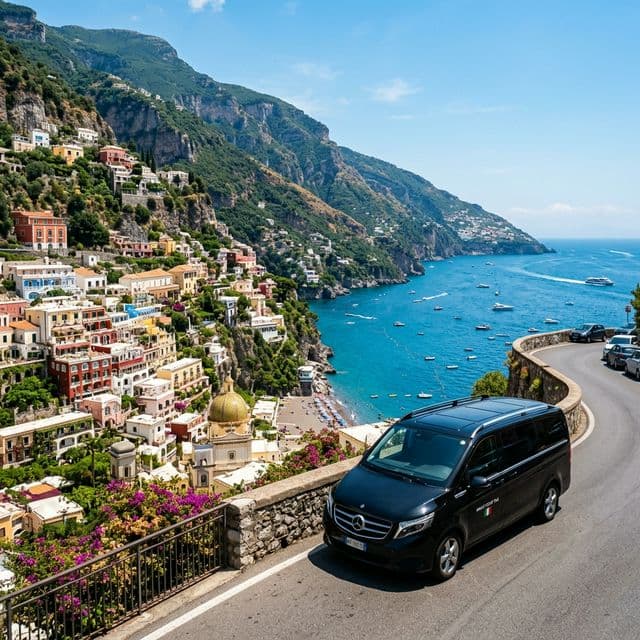
The Amalfi Coast is arguably Italy's most photographed stretch of coastline — pastel-coloured towns stacked into cliffs above a turquoise sea, connected by the narrow, winding SS163 coastal road. It's also, honestly, a long way from Rome, which is exactly why most visitors either stay overnight nearby or book a private day trip rather than attempt it independently.
A private day trip from Rome to the Amalfi Coast covers around 260 km each way — roughly 3 hours by motorway to Naples or Salerno, then the coastal stretch into Positano or Amalfi itself. It is a genuinely long day, but with a private driver handling the motorway miles, you arrive rested rather than road-weary, ready to actually enjoy the coast rather than just survive the drive to it.
Distance
~520 km round trip
Driving Time
~3 h each way
Why Choose a Private Day Trip
This is one route where a private transfer isn't just more comfortable than the alternatives — it's dramatically more practical. There is no direct train to the Amalfi Coast; the nearest stations are in Naples or Salerno, and public buses along the SS163 are notoriously slow, crowded in summer, and limited in how much luggage they'll take.
A private day trip also means your driver — not you — handles the coastal road itself, which is narrow, has blind hairpin bends, and is shared with tour coaches and scooters overtaking on the inside. You get to watch the view instead of the road.
Book This Day Trip
Instant confirmation · Professional drivers · Free cancellation
Secure Your Transfer
GET QUOTE
Need help planning? Contact us 24/7
WhatsApp SupportSuggested Itinerary
A Typical Day, Hour by Hour
| Time | Stop | What Happens |
|---|---|---|
| 6:30–7:00 AM | Early hotel pickup in Rome | Given the distance, an early start matters — your driver collects you before the city's own rush hour begins. |
| ~9:30 AM | Motorway drive via Naples/Salerno | The A1 and A3 motorways cover most of the distance quickly; the final approach onto the SS163 coastal road is where the scenery truly begins. |
| ~10:00 AM | Arrival in Positano | Time to wander the vertical town, its boutiques and viewpoints, or simply sit with a coffee looking out at the Li Galli islands. |
| 12:30–1:30 PM | Lunch with a sea view | A relaxed lunch at a cliffside restaurant — the coast's specialty is exactly this kind of view paired with fresh seafood. |
| 2:00–4:00 PM | Amalfi town and the Duomo | A short coastal drive to Amalfi itself, home to the striking striped Duomo di Sant'Andrea and the town's compact historic centre. |
| 4:00–5:00 PM | Optional Ravello detour | If time allows, the hilltop gardens of Ravello — Villa Rufolo and Villa Cimbrone — offer the coast's best panoramic views, a worthwhile climb for photographers. |
| ~8:00–9:00 PM | Return to Rome | The drive back retraces the motorway route; most guests are back at their Rome hotel by early evening. |
Every itinerary is fully customizable — tell your driver what matters most to you and the schedule adjusts around it.
Best Photo Stops
- The classic Positano viewpoint from the SS163 road above town, with the Church of Santa Maria Assunta's tiled dome in the foreground
- Amalfi's Piazza Duomo and its striped Arab-Norman cathedral facade
- Villa Rufolo's gardens in Ravello, looking straight down the coastline
- The winding SS163 itself, especially the stretch between Praiano and Amalfi
- Positano's Spiaggia Grande beach from the water's edge, looking back up at the town
A Little History First
The Amalfi Coast towns trace their prominence back to the Maritime Republic of Amalfi, one of Italy's four historic seafaring republics (alongside Venice, Genoa and Pisa), which controlled significant Mediterranean trade routes from the 9th to 11th centuries before being eclipsed by its larger rivals. Amalfi's Duomo still reflects that era's Arab-Norman trading connections in its striped, almost Byzantine facade.
Positano, by contrast, was a relatively poor fishing village until the mid-20th century, when writers like John Steinbeck (whose 1953 essay effectively launched its modern fame) and the broader "Dolce Vita" era of Italian glamour turned it into the coast's most photographed and expensive town — a transformation from working harbour to global icon in barely two generations.
Things to Do
Positano's Spiaggia Grande
The town's main beach, backed by cafés and boutiques stacked up the cliffside — the best spot to simply absorb the view that made Positano famous.
Amalfi's Duomo di Sant'Andrea
A striking striped facade reached by a dramatic staircase, with a cloister and crypt beneath dating back to the 9th century.
Ravello's Villa Rufolo and Villa Cimbrone
Hilltop gardens with what many consider the single best panoramic view on the entire coast, and the setting for Wagner's "Parsifal."
Path of the Gods (Sentiero degli Dei)
A dramatic clifftop hiking trail between Bomerano and Positano — for those wanting one Amalfi Coast walk beyond the towns themselves.
Emerald Grotto near Conca dei Marini
A sea cave known for the eerie emerald-green light that filters through underwater openings, reachable by a short boat trip.
Where to Eat
La Tagliata, Positano
A fixed-menu, family-run spot up in the hills above Positano — hearty, home-style Campanian food rather than a tourist-priced sea view.
Ristorante La Marinella, Amalfi
Right on the water in Amalfi, known for its fresh catch of the day and unhurried, genuinely local atmosphere.
Cumpà Cosimo, Ravello
A long-running trattoria in Ravello serving generous home-style pasta — a favourite with locals for decades, not just visitors.
Family-Friendly
The Amalfi Coast rewards patient families more than very young children — the roads are winding (motion sickness is a real consideration) and the towns are built on steep steps rather than flat pavements. That said, older children and teenagers tend to love it: boat trips, gelato at every turn, and beaches worth the walk down. If travelling with young kids, consider building in more relaxed beach time and less walking between viewpoints.
The Luxury Experience
For a genuinely elevated version of this day, we can arrange a private boat excursion along the coast from Positano — seeing the cliffside towns from the water is a different experience entirely — combined with lunch at a Michelin-recognised restaurant and a Mercedes executive vehicle for the drive, so the only decision left is which view to enjoy with your coffee.
Shopping
Positano is known across Italy for its resortwear — linen shirts, sandals made to measure while you wait, and hand-painted ceramics that Amalfi and neighbouring Vietri sul Mare have produced for centuries. It's genuinely worth budgeting time (and luggage space) for this rather than treating it as an afterthought.
Wine Tasting
While the coast itself is better known for limoncello than wine, the hills just inland around Tramonti and Furore produce distinctive, little-exported reds and whites grown on steep, terraced vineyards — a stop can be arranged for those who want to taste wine that rarely leaves the region.
Best Time to Visit & Seasonal Tips
Late May to mid-June, and September into early October — warm, clear, and well before or after the August crowds that can add over an hour to the coastal drive alone.
July and August bring the heaviest coastal traffic of the year — the SS163 can genuinely crawl through Positano at midday in peak summer, adding real time to the drive. Late spring (May–June) and early autumn (September–early October) offer the same weather with dramatically less congestion, and are the months most repeat visitors and locals actually recommend.
What to Bring
- Comfortable shoes for steps and hills — flip-flops don't hold up well in Positano or Ravello
- Motion-sickness tablets if you're prone to car sickness on winding roads
- A light jacket for the breeze on boat trips or hilltop viewpoints
- Sun protection — coastal sun reflects strongly off the water
- A camera with a wide lens for the coastal panoramas
Vehicle Options & Your English-Speaking Chauffeur
Every driver is a professional, English-speaking chauffeur-guide, not just a driver — hotel pickup and drop-off is included, and the itinerary above is a starting point, fully customizable to what you want to see.
- Sedan — 1–3 passengers · comfortable saloon car
- Executive Sedan — Business-class comfort (Mercedes E-Class or similar)
- Minivan — 4–8 passengers with luggage
- Mercedes V-Class — Premium van for groups & families
- Luxury Van — VIP group travel in full comfort
- Group Minibus — Larger parties on request
Pricing
Given the distance, this is priced as a full-day charter — a single fixed fee for the vehicle and driver covering the entire round trip from Rome, regardless of how many stops you make along the coast. The price is agreed before travel and includes fuel, tolls and the driver's full day; meals, boat trips and any entrance fees are separate.
How Booking Works
Because this is a longer, motorway-heavy day, we recommend booking at least 3 to 4 days ahead, especially in summer, to guarantee your preferred early departure time. Tell us your hotel, ideal start time and which towns matter most to you, and we'll confirm a fixed price and a suggested itinerary before you pay anything.
Cancellation Policy
Free cancellation up to 48 hours before departure for this longer day trip (rather than the standard 24 hours), given the advance planning involved on our side for a full-day coastal itinerary.
Common Questions
Rome to Amalfi Coast Day Trip — FAQ
One of the world's great coastlines is closer than you think. Book your private day trip from Rome to the Amalfi Coast and let someone else handle the driving.
Book Your Day Trip Now