Ten of the best day trips from Rome, with honest travel times and a straight answer on each one: take the train, or book a private driver. From Tivoli and Ostia Antica to Orvieto, Assisi, Pompeii and Florence.
The best day trips from Rome fall into two groups: the ones the railway handles beautifully, and the ones it barely handles at all. Florence, Orvieto, Naples and Ostia Antica are train trips. Hadrian's Villa, Civita di Bagnoregio and the Castelli Romani are not — and pretending otherwise is how people lose half a day to bus connections.
Below are ten destinations reachable in a day from Rome, with a rough sense of how long each takes and a straight verdict on how to get there. No prices, no timetables — those change.
How to choose your day trip
Before the destination, pick a day type. Three questions decide almost everything:
- Is there a station near what you actually want to see? Orvieto and Florence: yes. Hadrian's Villa: no — the site sits in the countryside below the town.
- One stop or several? A single walled town works on rails. Three hill towns and a winery in an afternoon does not.
- Who's travelling? Two people with good shoes have different options from a family with a stroller, or anyone with a flight that evening.
If the first answer is "yes" and the second "one stop", take the train. Where they go the other way, the calculus changes. See our coverage areas page.
| Destination | Rough time from Rome (one way) | Best way there |
|---|---|---|
| Ostia Antica | Well under an hour | Suburban train |
| Tivoli (Villa d'Este) | About an hour by road | Either |
| Tivoli (Hadrian's Villa) | About an hour by road | Private driver |
| Castelli Romani / Frascati | Roughly 45 minutes by road | Train (one town) / driver (several) |
| Bracciano | Around an hour | Either |
| Orvieto | Roughly 1–1.5 hours by rail | Train |
| Viterbo | Around an hour and a half | Either; driver if combining |
| Civita di Bagnoregio | Roughly two hours by road | Private driver |
| Assisi | Around two hours | Either; driver saves the last mile |
| Naples / Pompeii | Just over an hour to Naples (high-speed) | Train plus a connection |
| Florence | Roughly 1.5 hours (high-speed) | Train |
Tivoli: Villa d'Este and Hadrian's Villa
Tivoli sits about 30 km east of Rome, up in the hills, with two UNESCO World Heritage sites that have almost nothing in common. Villa d'Este is a Renaissance garden of terraces and fountains, driven by gravity rather than pumps. Hadrian's Villa is an emperor's country estate: a small city of pools, baths and pavilions in romantic ruin.
Why go: the best value-per-kilometre trip near Rome. Two world-class sites, one hillside, under an hour away.
How long: about an hour each way by road. Both villas is a full day; either alone, a comfortable half day.
The verdict: here the split matters. Villa d'Este is in the centre of Tivoli and the train gets you close enough. Hadrian's Villa is not — it's out in the fields below, and from the station that means a local bus or a taxi you have to find twice. For both villas in one day, a private driver is the honest answer: door to door at each gate, car waiting while you walk the ruins. See our services for how a day hire works.
Ostia Antica: Rome's own Pompeii
Ostia Antica was Rome's port, and it is a genuinely large excavated Roman town — streets, apartment blocks, a theatre, mosaics still on the floor of the baths, all under umbrella pines. Quieter than Pompeii and far closer.
Why go: the best ancient site reachable from central Rome in the time it takes to cross some cities.
How long: well under an hour on the suburban rail line, then a short walk. Half a day.
The verdict: take the train. Public transport wins outright — the line runs to a station beside the site, and a car improves nothing. Save the driver for the trips that need one.
Castelli Romani, Frascati and Bracciano
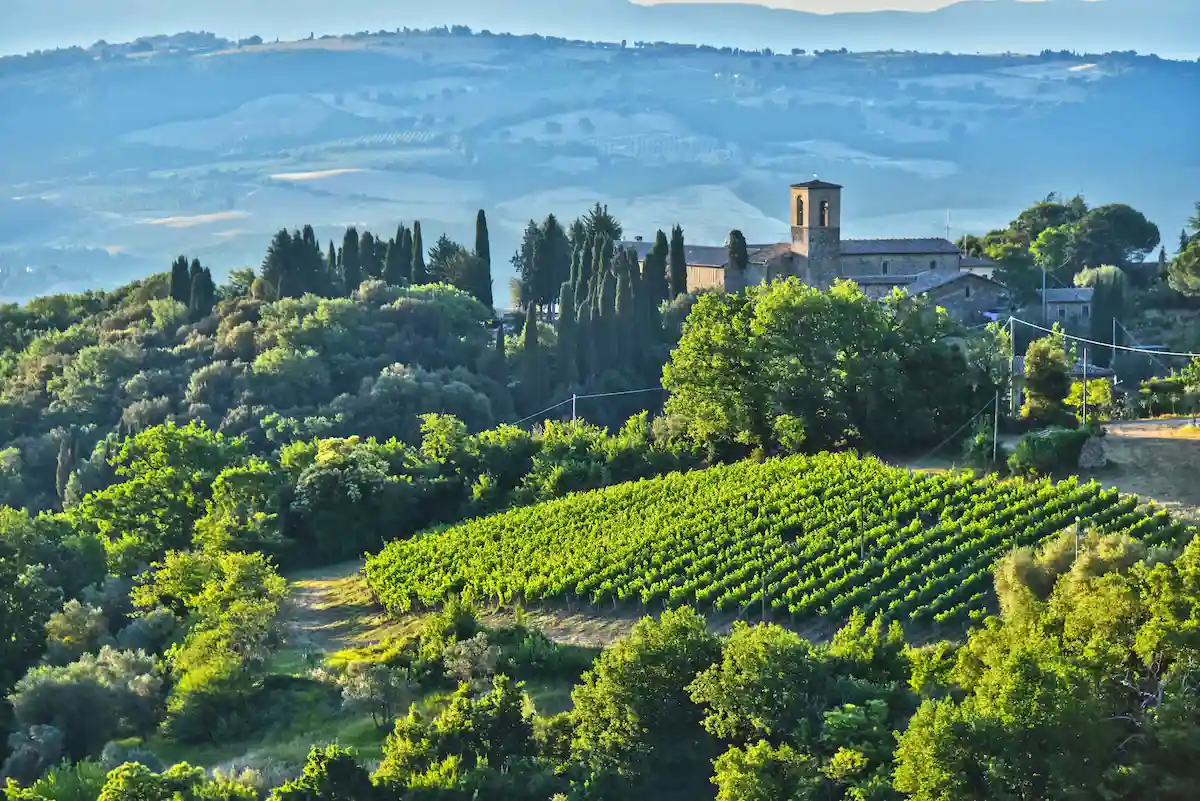
The Castelli Romani are the hill towns strung southeast of Rome — Frascati, Castel Gandolfo, Ariccia — sitting above the city among vineyards, with wine cellars, volcanic lakes and Sunday lunches that stretch. Bracciano, in the other direction, has a large lake and a castle above it.
Why go: this is what Romans do on a free day. Views over the city, food not priced for tourists, no queues.
How long: roughly 45 minutes by road to Frascati; around an hour to Bracciano.
The verdict: depends on your ambitions. One town, there and back? A train reaches Frascati and Bracciano fine. But the Castelli reward wandering between towns, and connections sideways from one to the next are slow and infrequent. Three towns and a lakeside lunch is a private-driver day — and the wine tasting stops being a driving decision.
Orvieto and Viterbo
Orvieto sits on a plug of tufa rock in Umbria, walls dropping straight to the plain, with one of Italy's most striking cathedrals: a striped Duomo with a facade like a jewellery box. Under the town lies a tunnelled world dug into the soft rock over centuries. Viterbo, closer to Rome, is a walled medieval city with an intact old quarter and a papal palace from the years the popes lived there rather than in Rome.
Why go: Orvieto is the easiest hill town in Italy to reach without a car. Viterbo is the medieval one nobody has heard of.
How long: Orvieto roughly one to one and a half hours by rail; Viterbo around an hour and a half.
The verdict: Orvieto is a train trip and a good one — the station sits below the cliff and a funicular carries you up. Viterbo works by rail too, though the regional line is slower. To pair it with the thermal springs nearby, or with Civita, a car earns its keep.
Civita di Bagnoregio: the town on the bridge
Civita di Bagnoregio is a tiny medieval settlement on an eroding pinnacle of rock, cut off from the mainland and reached only by a long pedestrian footbridge. There is no road in; the population is measured in dozens.
Why go: nothing else near Rome looks like it, and photographs undersell the walk across.
How long: roughly two hours by road each way. A full day, and worth one.
The verdict: private driver, and it isn't close. There's no station near Bagnoregio; by public transport it's a train to a nearby town then a local bus with limited runs, and missing the return makes for a long evening. A car takes you to the car park at the foot of the bridge and waits while you cross and wander. To build a day around it, start at our booking page.
Assisi
Assisi rises in pale stone on the flank of Monte Subasio in Umbria, and the Basilica of St Francis — UNESCO-listed, frescoed by the great names of early Italian painting — is why most people come. The town is the quiet reward: steep lanes, long views, a stillness that survives the crowds.
Why go: one of the most atmospheric towns in central Italy, and a genuinely moving building whatever you believe.
How long: around two hours each way. Long but very doable.
The verdict: either, with a caveat. Trains reach Assisi, but the station is down in the valley at Santa Maria degli Angeli — the hill town is a bus or taxi ride above it, so the last stretch is on you at both ends. With a driver you're set down near the top and collected where you finish walking, which on a hot day is not a small thing.
The long-haul trips: Naples, Pompeii and Florence
Pompeii sits near Naples, buried and preserved by Vesuvius, and remains the most complete Roman town anywhere. High-speed rail reaches Naples in just over an hour, with a local connection onward to the excavations. Take the train: no car beats it on that corridor. From Naples onward, if you'd rather skip the change or want Pompeii and Herculaneum together, a driver makes sense — rails for the long leg, a car for the awkward bit.
Florence is roughly an hour and a half from Rome by high-speed train, centre to centre: the least complicated recommendation here. Train, no contest — faster than driving, the station is in the middle of Florence, and the centre is restricted to traffic anyway, so a car would spend the day in a garage. A driver's only role is Roma Termini at the start and home at the end, which matters if you're out in the suburbs or leaving before dawn.
Train or private driver? The honest answer
Neither wins across the board. The pattern is consistent:
- Take the train for Florence, Naples, Orvieto and Ostia Antica. All four have a station where you want to be.
- Take a private driver for Hadrian's Villa, Civita di Bagnoregio, and any multi-stop Castelli day. The network never really planned for these.
- Either works for Tivoli town, Bracciano, Viterbo and Assisi — decide on your group, your energy, and how much of the day you'll spend solving connections.
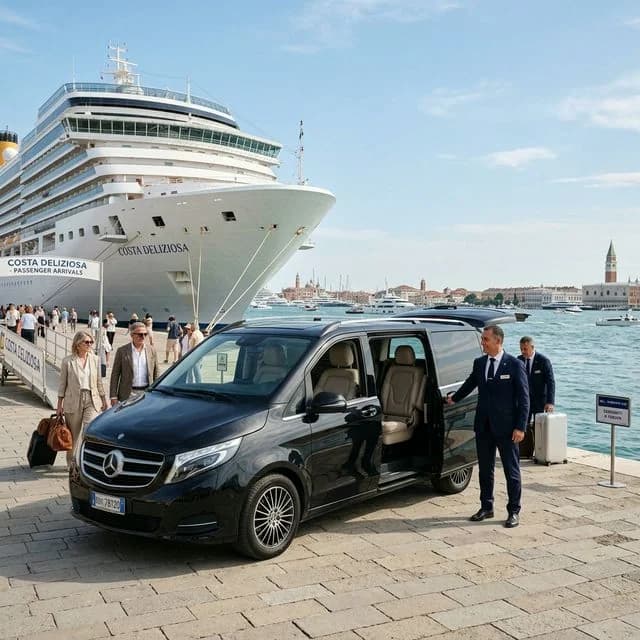
Be clear on what a driver is, though: door-to-door transport, a car waiting while you're inside, someone handling roads and parking — not guiding inside monuments, which is a licensed guide's job and a separate booking. What a car buys is time and the removal of the awkward last mile. Arriving or leaving on a flight? Our Rome airport transfer service covers the same ground, and there are more route guides on the blog.
Frequently Asked Questions
What is the best day trip from Rome if I only have time for one?
Tivoli, for most people: under an hour away, two UNESCO sites in Villa d'Este and Hadrian's Villa, gardens and ruins in one day without a long journey eating into it. If you want ancient Rome and nothing else, Ostia Antica is closer still.
Can you visit Pompeii from Rome in one day?
Yes, and plenty of people do: high-speed rail reaches Naples in just over an hour, with a local connection onward to the site. It's a long day rather than a relaxed one, so start early and accept you'll see Pompeii rather than Pompeii plus Naples.
Is Civita di Bagnoregio worth the trip from Rome?
If you have a few days in Rome and want somewhere that looks like nowhere else, yes. Be realistic about the logistics: no station nearby, no road into the town, and the final approach is a long footbridge on foot. Reckon on two hours by road each way.
Should I drive myself on day trips from Rome?
You can, but weigh it up: historic centres are ringed by restricted traffic zones with camera enforcement, parking in hill towns is tight, and the wine country around the Castelli is a poor fit for a designated driver. For rail-served destinations the train is easier; for the awkward ones, a driver removes the problem.
Does a private driver act as a tour guide at the sites?
No. A driver provides door-to-door transport and waits for you while you visit — that's the service. Guiding inside monuments is the job of a licensed guide, which you'd book separately.
Frequently Asked Questions
What is the best day trip from Rome if I only have time for one?+−
Can you visit Pompeii from Rome in one day?+−
Is Civita di Bagnoregio worth the trip from Rome?+−
Should I drive myself on day trips from Rome?+−
Does a private driver act as a tour guide at the sites?+−
Ready to Travel Italy Stress-Free?
Book a professional private taxi or airport transfer anywhere in Italy. Fixed prices, NCC-licensed drivers, meet & greet service — 24/7.

Written by
Italy Taxi Service Team
Expert travel writers sharing firsthand knowledge about transportation, airport transfers, and city navigation across Italy.